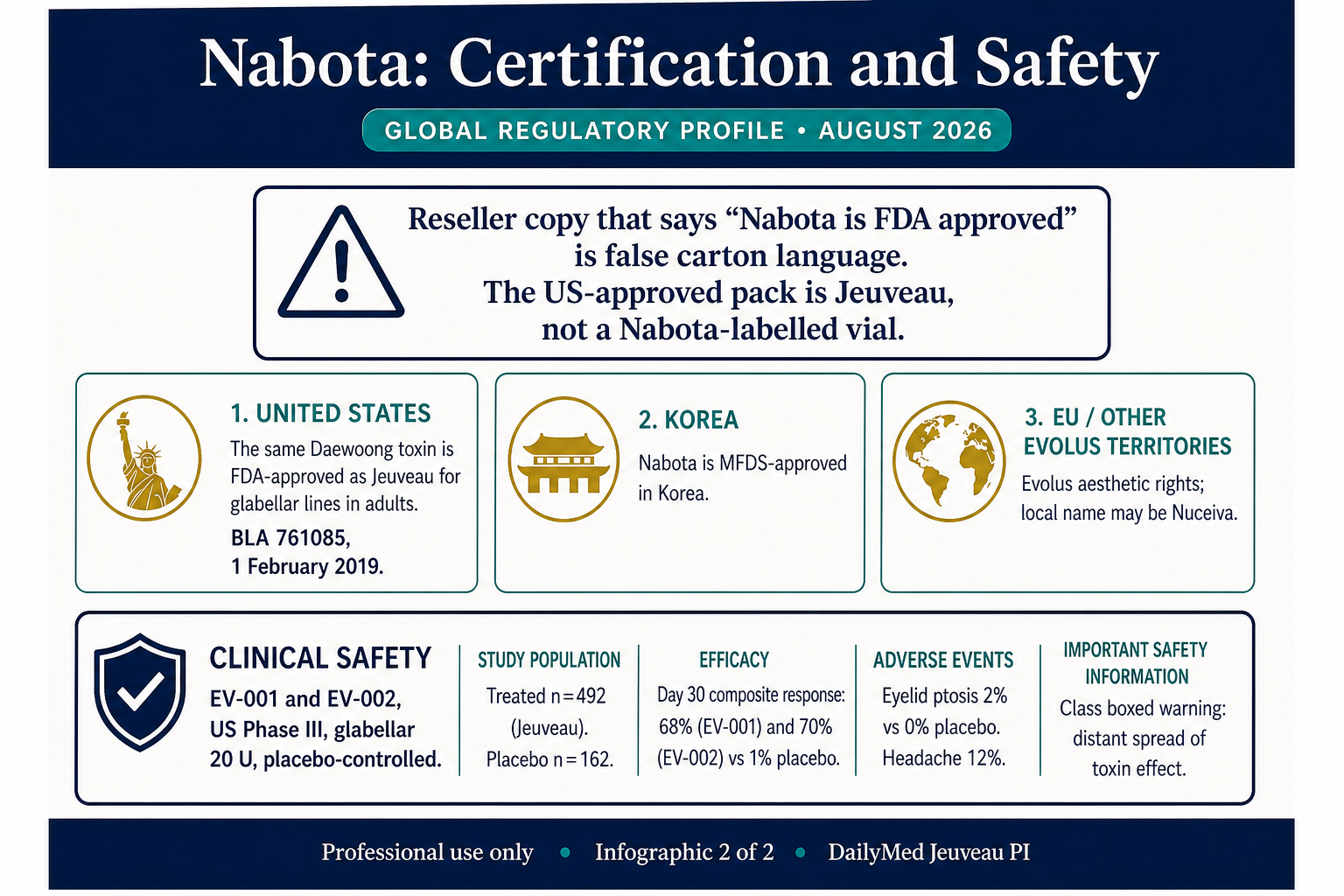
US product-page efficacy for glabella must follow DailyMed Table 3. Beer 2019 publishes the same trials to one decimal place; they round, they do not contradict. EVB-003 (Rzany 2020) is a Europe/Canada head-to-head on a different endpoint. None of these datasets make a Nabota-labelled vial FDA-approved.
EV-001 and EV-002 — DailyMed Copy-Safe
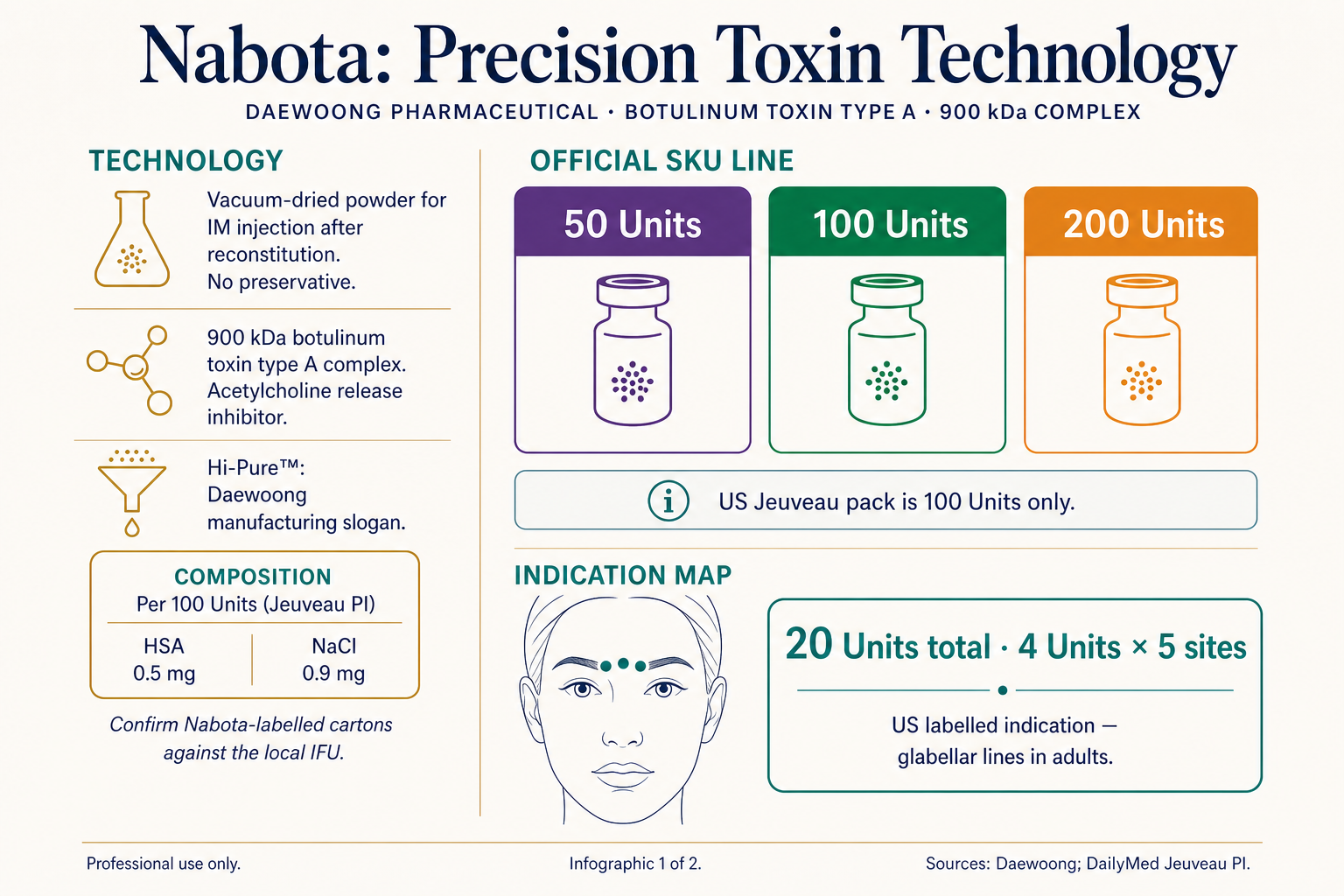
Two identical US randomised, multicenter, double-blind, placebo-controlled, single-dose trials. Dose 20U (4U × 5 sites). Primary endpoint: Day 30 composite, investigator and subject independently agree ≥2-grade improvement on 4-point GLS at maximum frown.
Composite investigator + subject ≥2-grade GLS improvement at maximum frown, Day 30 (DailyMed Table 3) | Trial | ClinicalTrials.gov | Jeuveau | Placebo |
| EV-001 | NCT02334423 | N=246 · 68% | N=84 · 1% |
| EV-002 | NCT02334436 | N=246 · 70% | N=78 · 1% |
Combined DailyMed randomised: 654 (Jeuveau 492 / placebo 162). Beer 2019 ITT: 67.5% vs 1.2% (EV-001) and 70.4% vs 1.3% (EV-002); both p<0.001. No SAE in either study was assessed as study-drug related. Demographics (DailyMed): mean age 51 years; 68 subjects (10%) ≥65; 91% women; 84% White; age range 18–81.
Adverse Reactions — DailyMed Table 2
AEs at higher frequency (≥1%) in Jeuveau vs placebo, EV-001 + EV-002 | Event | Jeuveau N=492 | Placebo N=162 |
| Headache | 57 (12%) | 21 (13%) |
| Eyelid ptosis | 8 (2%) | 0 (0%) |
| Upper respiratory tract infection | 13 (3%) | 1 (1%) |
| White blood cell count increase | 6 (1%) | 0 (0%) |
Open-label repeat-dose EV-004 (NCT02184988) and EV-006 (NCT02428608): n=922; 20U up to a maximum total of 80U; median 3 treatments; AE profile similar to single-dose trials (DailyMed). Immunogenicity (DailyMed §6.2): among 1,414 subjects treated with prabotulinumtoxinA-xvfs, 2 pre-existing antibodies and 2 treatment-emergent antibodies. Assay comparison across products may be misleading (label caveat).
EVB-003 — Different Endpoint, Do Not Substitute
Rzany BJ et al., Aesthetic Surgery Journal 2020;40(4):413–429, PMID 30951166. Europe/Canada Phase III vs onabotulinumtoxinA, 150-day, double-blind, 5:5:1 randomisation, n=540 (prabo 20U n=245; ona 20U n=246; placebo n=49). Primary: investigator GLS 0 or 1 at maximum frown on Day 30. Responder rates: prabo 87.2%; ona 82.8%; placebo 4.2%. Absolute difference 4.4% (95% CI −1.9, 10.8); lower bound greater than −10.0% → non-inferiority. SAE in 5 patients; none study-drug related. EMA SmPC Table 2 reports the same Day 30 investigator GLS 0/1 rates on the PP population. This supports non-inferiority to 20U onabotulinumtoxinA on that endpoint. It does not support unit interchangeability, superiority as a label claim, or “same as Botox” marketing. A 2022 male post-hoc (PMID 35922149) did not reach statistical significance between arms.
Won 2015 and Nam 2015 — Korean Programmes
Won CH et al., Int J Dermatol 2015;54(2):227–234, PMID 25311357. DWP450 vs onabotulinumtoxinA, n=268 randomised 1:1, 20U each. Physician-rating responder rates at week 4 (maximal contraction): DWP450 93.89%; OBoNT 88.64%. Non-inferiority: lower limit of 97.5% one-sided CI −1.53%, above the −15% threshold. Beer 2019 states this Korean comparator used the original formulation; the US/EU commercial product is vacuum-dried with a specified HSA source. Quote Won 2015 as the original-formulation Korean H2H, not as the Jeuveau BLA primary analysis.
Nam HS et al., J Neurol Sci 2015;357(1–2):192–197, PMID 26233808. Post-stroke upper-limb spasticity, n=197 (Nabota 99 / Botox 98). Wrist-flexor MAS change to week 4: −1.44 ± 0.72 vs −1.46 ± 0.77; difference 0.0129 (95% CI −0.2062 to 0.2319), within non-inferiority margin 0.45. This supported MFDS approval for post-stroke ULS (secondary sources cite MFDS 7 December 2015). It is not a US Jeuveau indication.